
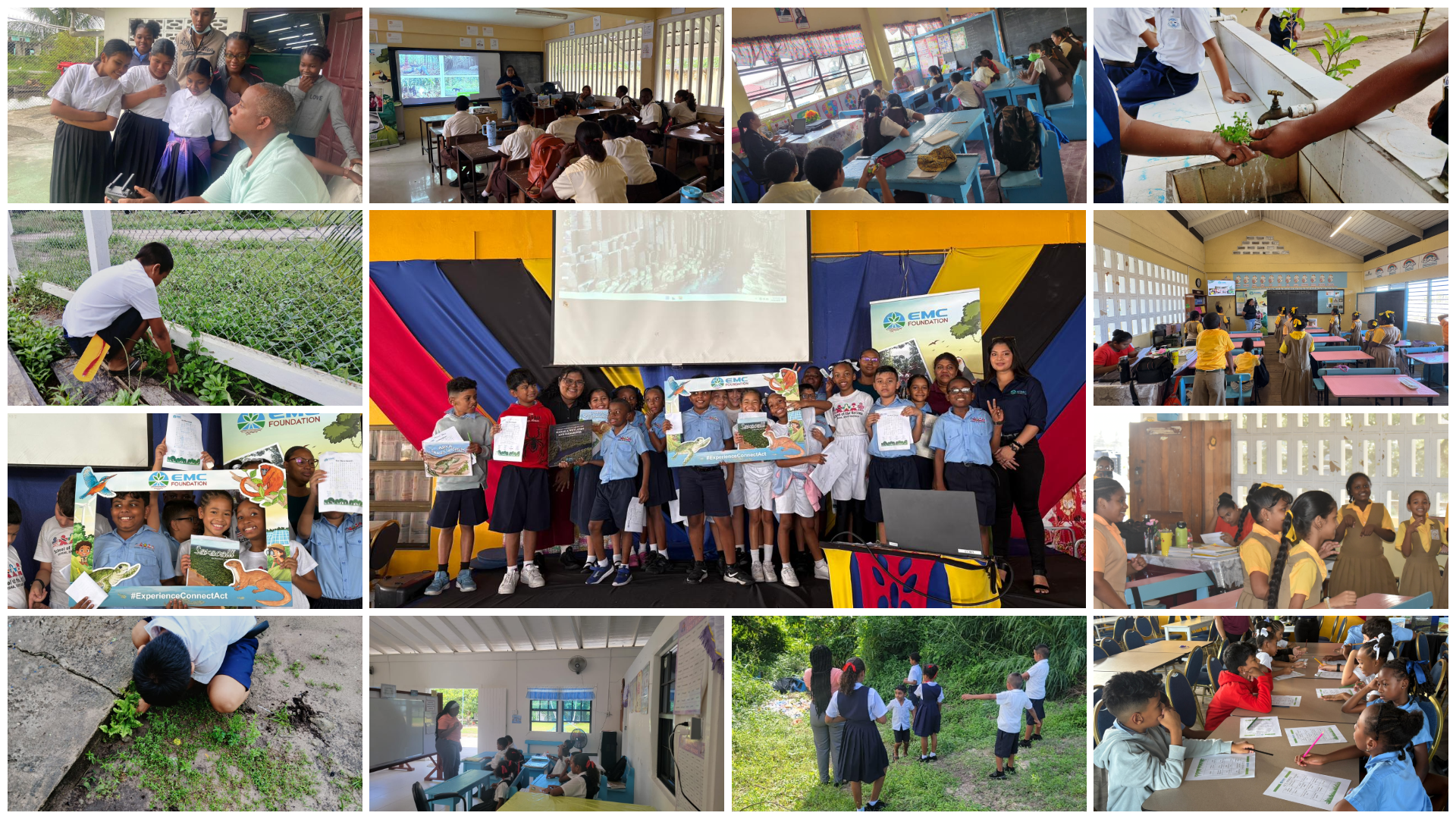
The EMC Foundation, through its E-STEM Program, continues to strengthen environmental education and awareness by collaborating with thirty-four environmental clubs across Guyana, with the support of ExxonMobil Foundation. These include Queen’s College, The Bishop’s High School, St. Stanislaus College, St. Rose’s High, Marian Academy Primary and Secondary, School of the Nations Primary and Secondary, Saxacalli Primary, De Hoop Primary, Little Biaboo Primary, St. Cuthbert’s Primary and Secondary, Moraikobai Primary, Santa Aratak Primary, Wakapau Secondary, Warapoka Primary and Secondary, Georgetown International Academy Primary and Secondary, Tapakuma Lake Primary, Lake Mainstay Primary and Secondary, Mashabo Primary School, Rosignol Primary School, Beterverwagting Primary School, Beterverwagting Secondary, Plaisance Primary, Chateau Margot Primary, Tuschen Secondary, Plaisance Secondary, La Bonne Intention Secondary, Tutorial High School, and Open Doors School.
During November 2025, the Foundation expanded its reach by partnering with two additional clubs. These are the Beterverwagting Primary School and the Tutorial High School, furthering our mission to empower youth through environmental science and technology education.
For the Primary ‘Ecosystems’ Work Plan for November 2025, the topics completed were Ecosystems, Maps and Drones, Global Positioning Systems (GPS), Plant Identification, Plant Adaptations, and Animal Adaptations. The club members learned about the types of ecosystems, threats to the ecosystems, and measures to protect these ecosystems. They learned about food chains, their various parts and the organisms involved, as well as how animals are adapted for their various habitats. They learned about how maps, compasses, and GPS can protect ecosystems and animals. The club members drew pictures, created posters and dioramas, watched videos and presentations and engaged in class discussions. They also did field trips to conduct plant and animal identification exercises and held discussions on plant and animal adaptations.
For the Primary ‘Responsible Waste Management’ Work Plan for November 2025, the topics completed were Waste Disposal and Noise Monitoring. For Waste Disposal, the club members defined the terms and discussed real-life scenarios to aid in the understanding of the topic. They learned and discussed the various steps to proper waste disposal, the impacts of improper waste disposal and preventative measures. For Noise Monitoring, the club members discussed the causes of noise pollution, its effects on human health and other species, the types such as traffic, industrial activities, loudspeakers, household sources and preventative measures.
At the Secondary level, the focus was on Ecosystem Components and Interactions, and Animal Identification. The club members explored the parts of an ecosystem, types of ecosystems and various cycles which make an ecosystem work. They learned about the various biodiversity found in ecosystems, the various cycles and relationships that they comprise. The club members explored the concept of animal classification by learning how animals are grouped based on shared characteristics such as body structure, genetics, and behaviour. They viewed a video on both vertebrates and invertebrates, examining examples from each category, including sponges, insects, fish, reptiles, and mammals.
Throughout the month, over 120 students participated in the program, engaging in presentations, discussions, and creative projects that fostered both curiosity and practical understanding of the environment. These experiences not only deepened students’ scientific understanding but also inspired them to think critically about their role in protecting the planet. Students demonstrated awareness of key issues such as pollution prevention, composting, and water quality, while discussing ways they could contribute to a cleaner, greener future within their schools and communities.
The EMC Foundation remains committed to empowering youth through environmental education, ensuring that the next generation is equipped with the knowledge, skills, and passion to experience, connect, and act for a sustainable Guyana.
The EMC Foundation was established by Mr. Shyam Nokta, winner of the 2022 Anthony N Sabga Award for Entrepreneurship. The Foundation works to support environmental awareness and education in Guyana by promoting activities which encourage a greater understanding of the environment, creating a network to connect like-minded persons, and providing opportunities to experience Guyana’s rich natural environment.