
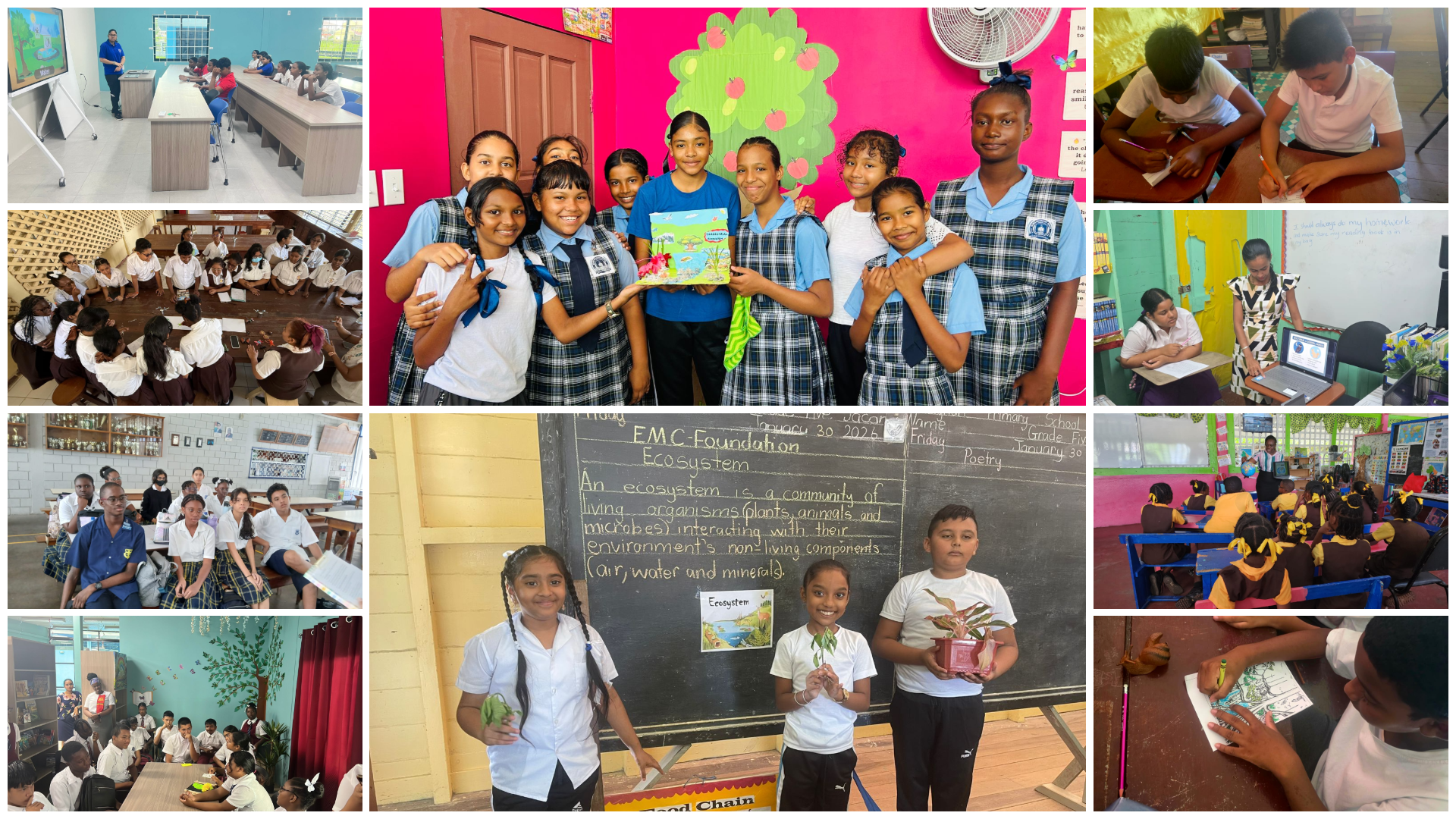
The EMC Foundation, through its E-STEM Program, continues to strengthen environmental education and awareness by collaborating with forty environmental clubs across Guyana. These include Queen’s College, The Bishop’s High School, St. Stanislaus College, St. Rose’s High School, Marian Academy Primary and Secondary, School of the Nations Primary and Secondary, Saxacalli Primary, De Hoop Primary, Little Biaboo Primary, St. Cuthbert’s Mission Primary and Secondary, Moraikobai Primary, Santa Aratak Primary, Wakapau Secondary, Warapoka Primary and Secondary, Georgetown International Academy Primary and Secondary, Open Doors Centre, Tapakuma Primary School, Rosignol Primary, Mashabo Primary, La Bonne Intention Secondary, Lake Mainstay Primary and Secondary, Annandale Secondary, Good Hope Secondary, Beterverwagting Primary and Secondary, Plaisance Primary and Secondary, Lusignan Primary, Tutorial High School, Chateau Margot Primary, Abram Zuil Secondary, Tuschen Secondary, Nismes Secondary, and Lake Capoey Primary.
In January 2026, the Foundation expanded its reach through partnerships with four additional clubs, Nismes Secondary School, Good Hope Secondary, Annandale Secondary and Lusignan Primary Schools, further advancing our mission to empower youth through environmental science and technology education. An additional ten clubs also expressed interest in joining the E-STEM Program.
For the Primary Ecosystems Work Plan in January 2026, the topics completed were Maps and Compasses and Animal Adaptations, during which the club members learned how to read maps and use compasses for navigation, as well as how animals survive in their habitats through structural, behavioural, and physiological changes. For the Secondary Ecosystems Work Plan, the topics that were completed include Ecosystem Components and Interactions, Ecosystem Functions and Nutrient Cycles, Types of Ecosystems, Biodiversity, and Interdependence and Relationships.
For the Primary Responsible Waste Management Work Plan, the completed topics were Composting, Pollution, Air Quality Monitoring, and Waste Audits. Club members took part in a range of engaging, hands-on activities focused on environmental awareness and action. These included learning about composting and how to use green and brown materials effectively, exploring the main types of pollution and ways to prevent them, conducting air quality monitoring using meters to measure key indicators such as PM2.5 and PM10, and completing a home-based waste audit to track, categorise, and analyse daily waste patterns for reporting and discussion.
For the Secondary Energy Efficiency Waste Management Work Plan, one of the clubs completed a session on Sources of Energy. They were introduced to the different sources of energy and learned to differentiate between renewable and non-renewable resources. Through discussions and debates, they compared advantages and disadvantages and explored which resources are most sustainable for the future.
Throughout the program, students created drawings, posters, and dioramas, viewed educational videos and presentations, and actively participated in class discussions. Field trips allowed them to conduct hands-on plant and animal identification exercises and further to examine plant and animal adaptations within natural environments.
Over 50 students participated in the program during the month, engaging in presentations, discussions, and creative projects that fostered curiosity, critical thinking, and practical understanding of environmental science. These experiences strengthened students’ awareness of key issues such as pollution prevention, composting, and water quality, while encouraging them to contribute to a cleaner, greener future within their schools and communities.
The EMC Foundation remains committed to empowering youth through environmental education, ensuring that the next generation is equipped with the knowledge, skills, and passion to experience, connect, and act for a sustainable Guyana.
The EMC Foundation’s E-STEM Program is being implemented with the support of the ExxonMobil Foundation.
The EMC Foundation was established by Mr. Shyam Nokta, winner of the 2022 Anthony N Sabga Award for Entrepreneurship. The Foundation works to support environmental awareness and education in Guyana by promoting activities which encourage a greater understanding of the environment, creating a network to connect like-minded persons, and providing opportunities to experience Guyana’s rich natural environment